Not during the appointment. You are fully numbed, and many patients describe the placement as easier than the extraction that preceded it. Sedation is available with monitoring if the prospect is what has been stopping you. Afterward, expect soreness and some swelling for a few days, settling steadily, managed with ordinary pain medication. Pain that worsens after the first few days, or that returns after a period of feeling fine, is worth a phone call.
Dental Implants in Binghamton and Vestal, NY
There are four things you can do about a missing tooth, and only one of them is doing nothing. This page sets all four against each other, then points you to the specific treatment that fits your situation.
Implant, Bridge, Denture, or Leave It
A dental implant replaces the root as well as the crown. A titanium post integrates with the jaw, and a crown is fitted on top. It does not involve the teeth either side, it keeps the bone loaded, and it is the most expensive option upfront.
A bridge spans the gap by crowning the teeth either side. Faster, no surgery, and usually less expensive. The cost is that two teeth get permanently cut down, and if they were healthy, that is a real price rather than a footnote.
A denture, full or partial, rests on the gums. The most accessible option, and the right answer for a great many patients. It moves, and the bone underneath keeps receding.
Leaving it is a real choice people make, and it is not free. What it costs is set out below.
Our Learning Center compares implants, bridges and dentures in more detail than fits here.
What the Gap Actually Costs You
Nothing hurts, so the consequences arrive quietly.
The bone goes first. Bone is maintained by the load a tooth root transmits when you chew. Remove the root and the ridge resorbs, most rapidly in the first year, and it does not come back on its own. This is the mechanism behind the collapsed lower face that people associate with age rather than with tooth loss, and it is why a denture that fit five years ago is loose now.
The neighbors move. The teeth either side of a space drift toward it and tilt as they go. The tooth in the opposing jaw, with nothing to meet, erupts further out of its socket. Neither can be reversed by later filling the gap; an implant stops further drift but does not pull anything back. Once teeth have tilted, straightening them out becomes an orthodontic problem on top of a restorative one.
The bite changes. Tilted teeth do not meet cleanly, and uneven contacts concentrate force where it was not designed to go. That shows up years later as cracked teeth, sore jaw joints and accelerated wear.
Every month the gap stays open, the eventual treatment gets more involved.
Bone that has already gone has to be rebuilt with grafting before an implant can be placed, which adds months and cost. Teeth that have tilted may need moving before anything can be fitted between them. None of this makes treatment impossible, and plenty of people have implants placed years after losing a tooth. It just gets longer and more expensive the further it is left, which is the opposite of how most people assume it works.
Which Implant Treatment Fits Your Situation
Implant dentistry is not one procedure. Find yourself below and start there.
One missing back tooth
Single tooth implants. One implant, one crown, and the neighboring teeth left alone. The most straightforward case we do, and the one where the choice against a bridge is clearest.
A missing front tooth
Front tooth implants. Same surgery, a much harder result, because the gum contour and the shade match have to hold up next to a natural tooth in daylight. The planning starts before the tooth comes out.
A whole arch, and you want it fixed in
All-on-4. A bridge screwed onto four implants, with the back two angled to use bone that survives tooth loss, which removes the graft from most cases. It does not come out.
A whole arch, and you want the cost down
Implant-supported dentures. A denture that clips onto two to four implants and lifts out at night. Considerably less expensive, easier to clean, and on a lower jaw it solves the complaint most denture wearers actually have.
Both arches, or you are not sure which route
Full mouth dental implants compares every full-arch option against the others, including how many implants each needs and what the maintenance involves.
Several problems at once
Full mouth reconstruction, where implants are one part of a sequenced plan that also involves gum treatment, crowns and a rebuilt bite. Planned by our board eligible prosthodontist.
What We Plan With
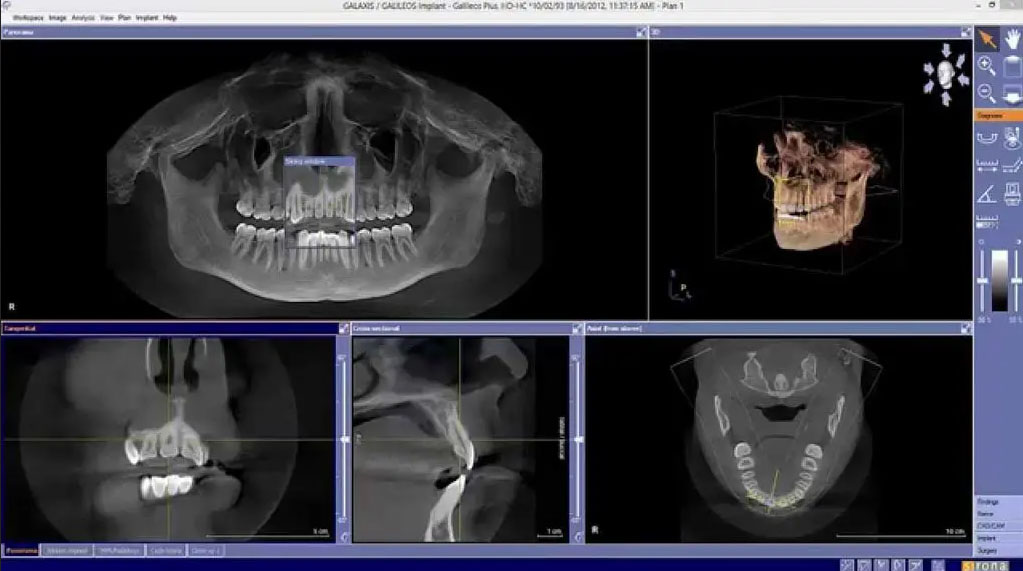
Orthophos SL 3D cone beam imaging. A three-dimensional scan of your jaw, taken in seconds, showing bone density, nerve position and sinus anatomy that a flat x-ray cannot. It uses less radiation than conventional cone beam units, though more than a routine intraoral x-ray, which is why it is taken when a case needs it rather than routinely.
Galileos Galaxis planning software. The scan is loaded into planning software where the implant is positioned virtually, in three dimensions, against nerves, blood vessels and soft tissue. It also shows where the implant will emerge, so the crown can be designed in the CEREC system and brought back into the plan. Both the implant and the crown are viewed together before anything is placed.
CEREC digital scanning and milling. A digital impression instead of a tray of putty, then the crown milled and glazed here on our CEREC system and Programat furnace. See our knowledge and technology for the rest.
The best staff, and Dentists I've encountered in our area! Excellent use of technology, in a relaxing environment.
Aaron G. · Google Review
Very Professional, Every visit is fun, laughable and the staff are caring, very knowledgeable, and will take the time and effort to make sure your visit is perfect. One of the only Dentist offices that I look forward to coming back to for all my dental needs.
William V. · Google Review
What It Costs, and Why Nobody Quotes a Number Online
Every case is different enough that a figure quoted before anyone has looked at your jaw is a guess. What moves the number is how many implants, whether extractions are involved, whether grafting is needed first, and what goes on top.
What we will do is give you a written figure before you commit, with your insurance benefits applied, and a figure for each alternative you are weighing so you can compare like with like. Coverage for implants is inconsistent between plans and usually capped by an annual maximum, and where it helps we phase treatment across two benefit years. We offer CareCredit, and our payment options page covers the plans we work with and the financing available.
Dental Implant Questions We Hear
-
Does getting an implant hurt?
-
Will it feel like a real tooth?Close, and closer than any alternative. Chewing force is substantially restored, it does not move, and you brush and floss it like a natural tooth. The honest difference is that an implant has no periodontal ligament, the tissue that lets a natural tooth register pressure and flex very slightly under load, so you feel bite pressure less precisely. Most people stop noticing within weeks. It also means an implant will not warn you about a heavy bite the way a tooth does, which is why we check and adjust the bite at every recall.
-
How long will an implant last?Implants have a strong long-term record, with the large majority still in function well beyond ten years, and many considerably longer. The crown on top is a separate question and wears like any restoration. What we will not tell you is that it is guaranteed for life, because that depends on things nobody can promise: cleaning, smoking, grinding and gum health. An implant is not immune to disease. The gum and bone around it can become infected in the same way as around a natural tooth, and faster once it starts, which is why the recall schedule matters more than the surgery.
-
How much time off work will I need?For a single implant, most people are back the next day, and scheduling before a weekend gives you a buffer if you would rather have one. Full-arch surgery is a bigger event and it is fair to plan for a quiet week rather than a quiet weekend. We will tell you which yours is when we schedule, so you can arrange things around it rather than after it.
-
Can I have implants if I have been told I do not have enough bone?Often yes. That answer was given more freely under older protocols than it would be now. Angling implants to use the bone that survives tooth loss removes the graft from many full-arch cases, and where bone genuinely is insufficient, grafting rebuilds it, which adds months rather than closing the door. Bring any previous scans to the consultation and we will tell you which of those applies to you.
-
Is there anything that rules me out?Few things rule it out outright, but several change the plan. Active gum disease is treated first, because placing an implant into an infected mouth is placing it into the problem. Smoking raises failure rates materially and we will be straight with you about that. Uncontrolled diabetes slows healing. Certain bone medications need discussing before anything is planned. Jaw growth also has to be finished, which is why implants are not placed in adolescents. Bring your full medication list to the consultation rather than a summary.
Let's talk about replacing that tooth.
A consultation includes a 3D scan and a clear explanation of every option open to you, implant, bridge or denture, with a written figure for each. There is no obligation, and no decision is made on the day.
Proudly Serving Patients in the Following Communities
- Apalachin NY
- Bainbridge NY
- Binghamton NY
- Castle Creek NY
- Chenango Forks NY
- Choconut PA
- Conklin NY
- Coventry NY
- Endicott NY
- Endwell NY
- Greene NY
- Harpursville NY
- Johnson City NY
- Kirkwood NY
- Little Meadows PA
- Maine NY
- McDonough NY
- Norwich NY
- Owego NY
- Oxford NY
- Port Crane NY
- Port Dickinson NY
- Triangle NY
- Vestal NY
- Windsor NY