No. That is the practical advantage of having the specialty in a general practice. You can book a consultation directly, and if you are already a patient here your records and images are already on file. If you are coming from another practice, bring any recent x-rays or a treatment plan you have been given and we will go through it with you.
Prosthodontics in Vestal, NY
Prosthodontics is the dental specialty for replacing teeth and rebuilding bites. It covers the largest and least reversible work in dentistry: implants, full arch restoration, dentures, crowns and the planning that holds a complex case together.
This page covers what that specialty actually is, when it makes a difference to your outcome, and which of our treatments fall under it.
What a Prosthodontist Is, and When You Need One
A prosthodontist completes four years of dental school and then a three-year residency accredited by the American Dental Association. Prosthodontics is one of the twelve recognized dental specialties, and the residency is spent almost entirely on the restoration and replacement of teeth.
For a filling or a single crown it changes nothing. It starts to matter when several decisions depend on each other: a whole arch, a bite that has collapsed from years of wear, multiple failing restorations, or an implant case where the position of the teeth has to be decided before the position of the implants. Somebody has to hold the finished result in their head while the parts are being made, and that is what the training is for.
Most complex cases in this region get referred out. Ours do not leave the building.
The usual path for a large case is a general dentist who plans it, an outside surgeon who places the implants, and a laboratory that never meets you. Every handoff is a chance for the plan to drift. Here the imaging, the surgery, the milling and the ceramic furnace are in one place, and the person who designs the teeth is in the same building as the person who places the implants.
The Doctors Behind Your Care
Two of our dentists lead this work, and the split between them is worth understanding before you book.
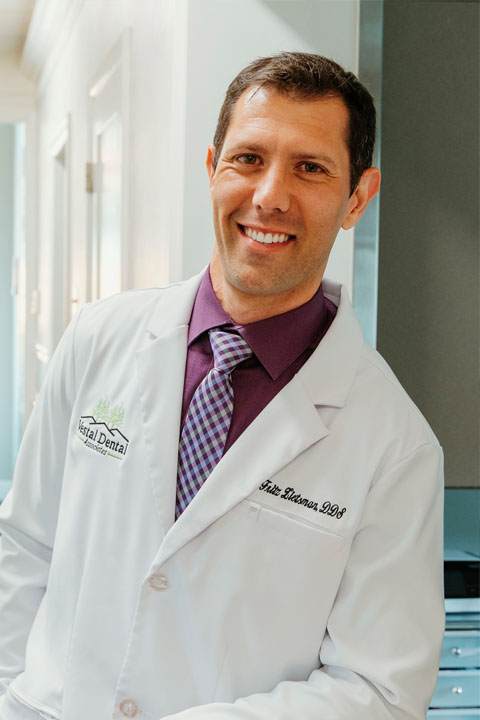
Dr. Fritz Zietsman, DDS, Board Eligible Prosthodontist
Dr. Zietsman carries the specialty training described above, and it is uncommon to find it inside a general practice rather than at a referral center. His work here is the reconstructive end: full mouth reconstruction, complex implant prosthetics, All-on-4 restorations, implant-supported dentures and bite management.
If you have significant tooth loss, restorations failing together, or a bite that has changed shape over the years, his is the opinion worth getting, and you do not need a referral to get it.
Learn More About Dr. ZietsmanDr. Nolan Robinson, DDS, Restorative and Implant Dentistry
Dr. Robinson works across the full range of surgical and restorative procedures, with a focused clinical practice in complex restorations, dental implants, crowns and bridges, dentures and smile makeovers.
Patients tend to describe his approach before they describe his work, which is a good sign in this part of dentistry, where the appointments are long and the decisions are permanent.
Learn More About Dr. Robinson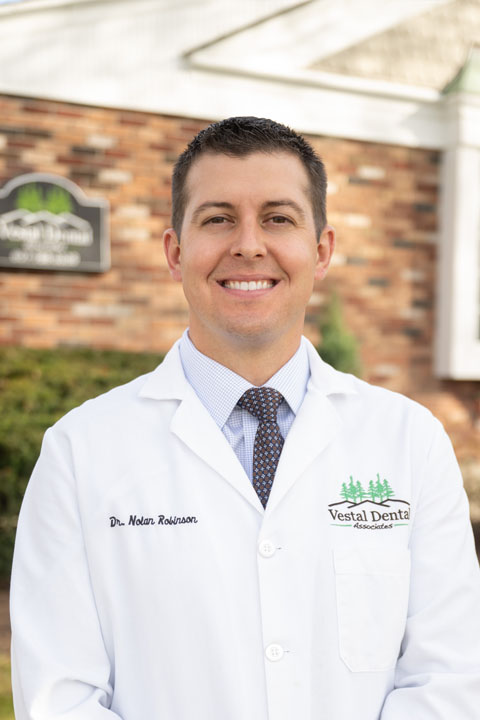
I was worried I would never feel as comfortable with another dentist as I did with Dr. Farrell, but I have been so pleasantly surprised with the staff at Vestal Dental! I've only seen Dr. Nolan, but I can tell you he is absolutely phenomenal!! He's professional, personable, and so genuine. He truly cares about his patients, and makes you feel as if he's known you forever.
KellyAnn D. · Google Review
Where to Go From Here
Each of these has a page of its own. Start with whichever describes your situation.
Rebuilding a whole mouth
Full mouth reconstruction is the coordinated plan for when several problems arrive together: tooth loss, decay, bite collapse, gum disease, failing restorations. Sequenced so the foundation is sound before anything is built on it.
Replacing a full arch with implants
Full mouth dental implants compares every full-arch route against the others, including the one question that decides the price: whether the prosthesis comes out at night. All-on-4 covers the fixed four-implant technique. Implant-supported dentures covers the removable version.
Replacing one tooth or a few
Single tooth implants for a back tooth, and front tooth implants where the gum contour and the shade match are the harder half of the job.
Dentures
Modern dentures, full and partial, and what separates a set that fits from one that never feels right. The answer is mostly in the records taken before anything is made.
Crowns, bridges and cosmetic work
Crowns and bridges restore broken and structurally compromised teeth, with many of them milled and glazed here in one appointment on our CEREC system. Smile makeovers and veneers cover the appearance-led end.
Prosthodontics Questions We Hear
-
Do I need a referral to see the prosthodontist?
-
Does everything have to go through a prosthodontist?Not at all, and it would be a poor use of the specialty if it did. Routine restorative work is handled by the dentist you normally see. What the specialty is for is the complex end: a whole arch, a collapsed bite, a case where the order of treatment determines whether it lasts. We will tell you which of those yours is at the consultation rather than routing everything through one chair.
-
What does "board eligible" mean?It means the residency is complete and the training requirements for board certification are met, with the certification examination process still in progress. The clinical training behind the title is the same three-year ADA-accredited residency either way. We use the term precisely rather than loosely, and we would rather you knew exactly what it describes.
-
I have been quoted for a large case elsewhere. Will you look at it?Yes, and it is a reasonable thing to do before committing to work of that size. Bring the written plan and any imaging. We will tell you what we would do differently and why, and sometimes the answer is that the plan you have is a good one. A second opinion on a five-figure treatment plan is not an insult to whoever wrote it.
-
How long does a complex case take?Anywhere from a few months to over a year, and almost all of the difference is healing rather than appointment time. Implants need three to six months to integrate, grafts need time before that, and gum treatment has to settle before restorations are made. You get a dated, phased plan at the start so you can see where each stage falls and work around anything you have coming up.
-
How is this paid for?Restorative and periodontal elements with a clinical justification are often covered in part, subject to an annual maximum that a large case will exceed. Implants are covered inconsistently and cosmetic elements generally are not. We split the plan into what is likely to attract coverage and what is not, give you both figures rather than one total, and phase treatment across benefit years where that genuinely helps. Our payment options page covers the plans we work with and the financing available.
Whatever stage you are at, we can help.
A consultation with 3D imaging produces a written plan with a clear sequence, timeline and cost for each stage. Second opinions on plans from elsewhere are very welcome.
Proudly Serving Patients in the Following Communities
- Apalachin NY
- Bainbridge NY
- Binghamton NY
- Castle Creek NY
- Chenango Forks NY
- Choconut PA
- Conklin NY
- Coventry NY
- Endicott NY
- Endwell NY
- Greene NY
- Harpursville NY
- Johnson City NY
- Kirkwood NY
- Little Meadows PA
- Maine NY
- McDonough NY
- Norwich NY
- Owego NY
- Oxford NY
- Port Crane NY
- Port Dickinson NY
- Triangle NY
- Vestal NY
- Windsor NY