For a short stretch while you arrange something better, yes, and for very light occasional grinding some people get on fine with a boil-and-bite for a while. We would rather you wore something than nothing. Where it stops being good enough is if you grind heavily, if you have crowns or veneers to protect, or if you have already tried one and it is living in a drawer. That last one is the most common answer by a distance.
Custom Occlusal Night Guards in Vestal, NY
You have probably already worked out that you grind. Either a partner told you, or you woke up with a sore jaw once too often, or a dentist pointed at teeth that are flatter than they should be for your age.
So the question is not really whether to protect them. It is which guard, and whether the custom one is worth several times what the pharmacy charges. This page covers what a night guard does, when it helps, and when something else is the better answer.
Drugstore, Boil-and-Bite, or Custom
The stock drugstore guard. A one size fits nobody tray. It is bulky, it does not stay put, and because it does not stay put most people stop wearing it within a couple of weeks. It is genuinely better than nothing for a few nights while you sort something out. As a long term answer it mostly protects the shelf it sits on.
The boil-and-bite. Softened in hot water and bitten into, so it does at least have some relationship to your teeth. Better retention than a stock guard, at modest cost. Two real problems: the soft material is pleasant to chew, so heavy grinders sometimes clench harder into it rather than less, and it wears through fast. It also thins exactly where you bite hardest, which is where you needed the thickness.
The custom splint. Made from an impression or scan of your actual teeth, in a hard or hard-soft laminate material, fitted and adjusted in the chair, using the same digital scanning we use across the practice. It stays where it is put, it does not trigger a gag reflex, it distributes force across the whole arch rather than concentrating it, and it lasts years rather than months. The reason to buy one is not that it is fancier. It is that people wear it.
The only guard that protects anything is the one you actually put in every night.
Comfort is not a luxury feature here, it is the entire mechanism. A guard that irritates you is a guard in a drawer, and a guard in a drawer performs exactly as well as no guard at all.
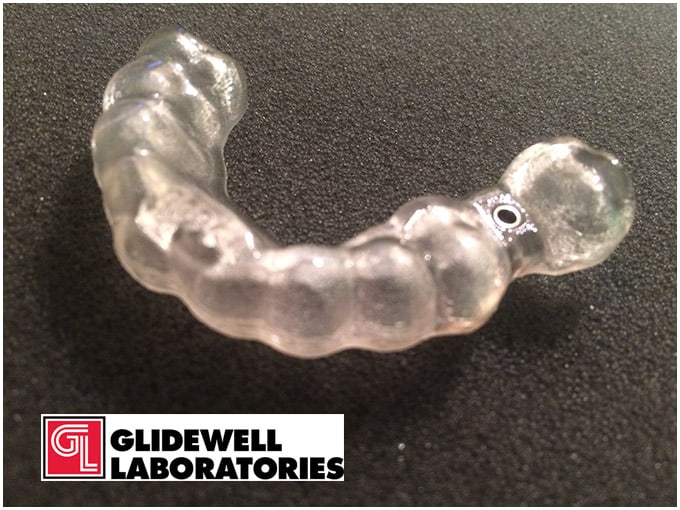
We use the Glidewell Comfort H/S bite splint, a laminate with a hard outer shell and a softer inner surface.
The hard exterior takes the grinding force and resists wear. The softer layer against the teeth is what makes it tolerable to sleep in. It can be made for the upper or the lower arch, and it protects existing crowns and veneers, which is often what makes it worth the money on its own.
Hard, Soft, or Both, and Which Arch
These are not interchangeable, and the right choice depends on what your jaw actually does at night.
Soft guards suit light grinders and are the most comfortable straight away. For a heavy clencher they can make things worse, because chewing into something yielding invites more muscle activity rather than less.
Hard acrylic guards are the durable option and the usual choice for serious grinding. They take some getting used to.
Hard-soft laminates, which is what we fit by default, aim at the middle: the durability of the hard surface with an inner layer that makes it wearable from the first night.
Upper or lower is usually your dentist's call based on your bite, existing restorations and whether you gag easily. Neither is universally correct and anyone who insists otherwise is overselling.
Living With One
Rinse it in cool water as soon as you take it out, brush it gently with a soft brush and no toothpaste, since abrasives scratch the surface and scratches harbor bacteria. Let it dry fully before it goes back in its case. Never use hot water, which warps it, and keep it away from pets, who find them irresistible.
A well made custom splint typically lasts several years, though a determined grinder will get through one faster, and how quickly you wear through it tells your dentist something useful about how hard you are actually working at night. Bring it to every checkup so we can inspect the fit and the wear. Our Learning Center covers how to tell whether you need one in the first place.
It should feel snug and slightly odd for a few nights, then unremarkable. It should not hurt, make teeth ache in the morning, or change how your teeth meet during the day. If any of that happens, call us for an adjustment rather than giving up on it.
You will not get better service anywhere else. The entire team is amazing... I trust his word on whatever he says, and what he says always makes sense. They can show you via camera exactly what work you need, or don't need.
Michael C. · Google Review
What a Night Guard Will Not Do
Worth being straight about the limits, because they are routinely oversold.
It will not stop you grinding. Bruxism originates in the brain and in sleep, not in the mouth, and a splint does not switch it off. What it does is take the damage, so your enamel does not have to. Where grinding has already flattened teeth, rebuilding them is a separate and considerably larger conversation.
It is not a cure for jaw joint disorder either, though it is usually a central part of managing one. If your problem is a clicking or locking joint rather than worn teeth, start on our TMJ and neuromuscular dentistry page, where the diagnosis and the full treatment ladder are covered properly.
And it is not the same thing as a sports mouthguard. Different material, different thickness, different job, and neither substitutes for the other. If you need protection on the field, see sports mouth wear protection.
Night Guard Questions We Hear
-
Is a drugstore guard ever good enough?
-
How long will a custom guard last?Typically several years with reasonable care. Heavy grinders go through them faster, and that is useful information rather than a defect. If you wear through a hard splint in under a year, it tells us the grinding is significant and worth addressing beyond just replacing the appliance. Bring it to your checkups and we will tell you when it is getting close.
-
Will wearing it change my bite?A properly designed and adjusted splint should not. This is a real concern with some appliance designs and with guards that cover only some of the teeth, because a partial coverage appliance can allow uncovered teeth to move. That is one of the practical arguments against improvising with something bought off a shelf. If your bite feels different during the day, stop wearing it and call us.
-
How do I clean it properly?Rinse in cool water immediately after taking it out, then brush gently with a soft toothbrush and water. Skip the toothpaste, it is abrasive enough to scratch the surface. Let it air dry completely before storing it in a ventilated case. A denture cleaning tablet once a week keeps it fresh. Never hot water or the dishwasher, both will warp it permanently.
-
I only clench during the day at my desk. Does this help?Not directly, since you are not going to wear a splint at work. Daytime clenching responds better to becoming aware of it: teeth should be apart at rest, with lips together and the tongue on the roof of the mouth. Phone reminders sound silly and work surprisingly well. Plenty of people do both, clench by day and grind by night, so it is worth an examination either way. Our Learning Center covers the grinding and jaw pain connection in more depth.
-
Does insurance cover a night guard?Many dental plans cover occlusal guards, often at a percentage and frequently with a frequency limit of one every few years. Some exclude them entirely, and some cover them only when coded for bruxism rather than for TMD. We will check your specific benefits and give you a written estimate before anything is made. Our payment options page covers the plans we work with.
A short appointment that protects a great deal.
Fitting a night guard takes one brief impression visit, and it then protects your teeth, your restorations and your jaw for years. Call us and we will talk through whether one would help you.
Request an Appointment
Proudly Serving Patients in the Following Communities
- Apalachin NY
- Bainbridge NY
- Binghamton NY
- Castle Creek NY
- Chenango Forks NY
- Choconut PA
- Conklin NY
- Coventry NY
- Endicott NY
- Endwell NY
- Greene NY
- Harpursville NY
- Johnson City NY
- Kirkwood NY
- Little Meadows PA
- Maine NY
- McDonough NY
- Norwich NY
- Owego NY
- Oxford NY
- Port Crane NY
- Port Dickinson NY
- Triangle NY
- Vestal NY
- Windsor NY